Stairs in a Dream: What Every Step Is Telling You
Few dream scenes are as ordinary as a staircase — and yet. You climb it at a slow pace or tumble down it, a step is missing or it sinks into darkness, it leads to a sunlit attic or slams into a wall. For centuries stairs were the only feature connecting a house's levels, from cellar to light. That is exactly their dream work. Read them as a progress report: serene ascent, exploratory descent, tumbling fall, missing step, endless flight — each scene a message. This guide walks through the symbolism of ascent by degrees, from Mesopotamian ziggurats to Escher's impossible staircases, its psychological and spiritual readings, and details each classic scenario.
Symbolism and Culture
Humanity's first staircase rose toward the sky: in Mesopotamia, the ziggurat of Ur climbed by tiers to approach the gods, and the Tower of Babel was only its over-built version. The Book of Genesis adds a dreamlike touch: at Bethel, Jacob falls asleep on a stone and sees a ladder set on the earth whose top reaches heaven, angels ascending and descending on it; when he wakes, he names the place God's house. Between earth and heaven, he understood, there are no leaps — only degrees. In Rome, pilgrims still climb the Scala Santa on their knees, step after step, as if ascent demanded the body before the spirit. In the seventh century, John Climacus wrote up a monk's curriculum in the thirty degrees of The Ladder of Divine Ascent, from renunciation to love — and a celebrated Byzantine icon shows monks climbing while demons tug at their garments. In 1961, Escher closed the file: the monks of Ascending and Descending climb forever without ever rising — the final symbolic warning: progress happens only when the degrees lead somewhere.
Psychological Interpretation
Jung compared the psyche to a house: the ground floor hosts ordinary conscious life, the cellar what lies buried, the upper storeys the higher levels of consciousness. In his famous dream of the house, he descended level by level and found, under each floor, deeper historical strata — Roman remains, bones, primitive pottery: the house, like the soul, has a layered history. Stairs, for him, are not a place but a transition: the connection between two levels tells how one state of consciousness passes into another. Freud read climbing and falling in dreams as bodily sensations encoded in the image: the rhythm of climbing legs, the shortness of breath, the pulse. Contemporary psychology adds the core finding: we progress in small steps — and the dream says so. Every step cleared closes a stage; a missing step is a gain not yet gained; a tumble signals a rise that climbed faster than your foundations could hold. And a landing is not failure: it is the necessary breathing between two flights.
Spiritual Dimension
Dante shapes Purgatory's purifying climb into seven terraces, each undoing one attachment; at every transition an angel pronounces a beatitude — on the holy mountain you sing what you surrender as you rise. In the seventh century, John Climacus drew up for one monk the thirty degrees of The Ladder of Divine Ascent, from renunciation to love; a celebrated Byzantine icon shows monks climbing while demons tug at their robes: spiritual progress counts time, and falling is scheduled into the exercise. Sufism speaks of maqamat, the stations of the path: you do not reach God in a leap but in stations — those who burn through the stages fall back. And the Quran calls God the 'Possessor of degrees of ascent' (Surah al-Ma'arij). The dream of stairs thus opens a precise spiritual review: do you believe you can skip stages, or do you accept the next step — the only one actually within reach?
Dream Situations
- Climbing sound stairs without effort: your evolution is underway, and every cleared step closes a stage.
- Climbing without ever reaching the top: Escher's loop — effort missing a destination.
- Descending stairs with composure: a voluntary dive into your unexplored inner layers.
- Meeting a missing step or a gap in the flight: a skipped stage still asking to be cleared.
- Tumbling down the stairs: a rise that climbed faster than your foundations could hold.
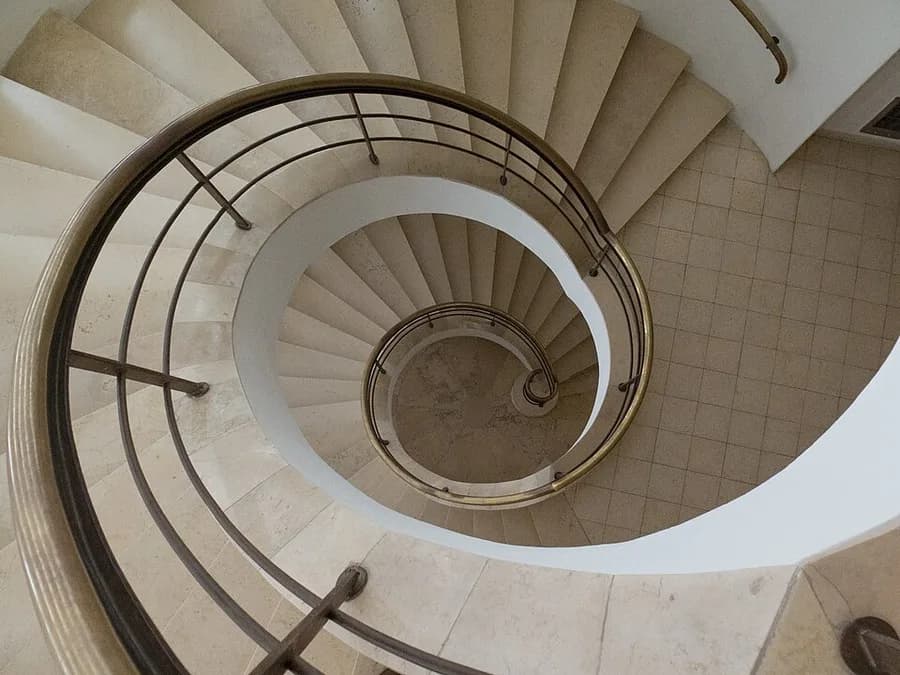
- Climbing a spiral staircase: a path coiling around itself, where ascent happens in circles.
- Rickety stairs or worn treads: the foundation of your progress is not yet solid.
- Searching in the dark for stairs you cannot find: the target is still poorly drawn — light the direction first.
Frequently Asked Questions
Why do I never reach the top of the stairs in my dream?
Does descending stairs always signal a setback?
Why do I keep climbing the stairs of my childhood home?
What does the missing step in my dream represent?
Questions and Answers
Why do the stairs never end in my dream?
That is Escher's loop: progression exists, destination does not. The dream stages effort running idle precisely when the endpoint is unnamed. The key is to redraw the top floor: what are you actually trying to reach?
Does going down stairs always mean failure?
No: upward is not always virtue. A calm descent may be an exploratory dive into your inner layers, in Jung's sense. What weighs is haste, not direction. A forced descent is recognizable by the dreamer's ragged breathing.
Why do I keep climbing my childhood staircase?
The childhood home is the psyche's foundational stratum: returning to climb it is revisiting the stairwell where your beliefs were laid down, step after step. The dream invites you to revise a step rather than a destination.
What does the missing step in a dream staircase mean?
It names the stage you are trying to skip. The dream rejects shortcuts the way reality does: the aim is not the next floor but the next step — naming what in your life must be cleared before you rise.
Why is the top of the stairs dark or out of sight?
The unconscious does not project the destination ahead of time: it shows the visible flight, not the top floor. Major evolutions read as a sequence of landings, not a finish line. Trust the next step, not an imagined summit.