Flying in a Dream: Elevation, Freedom or the Urge to Flee?
Few dreams leave such a physical memory: wind on your face, the earth dropping away, that unthinkable lightness. Flying ranks among the most cherished dreams — and the most unevenly lived: some wake euphoric, ready to dare anything; others with a pounding heart, relieved to have survived the altitude. For the oniric take-off asks everyone the same question: what are you doing with your freedom? This guide crosses the symbolism of flight through the cultures, its psychological and spiritual readings, then details the classic scenarios — the wingless take-off, the laborious flight, the flight for two — to help you recognise what yours announces: an elevation, a hard-won maturity, or the need to stop fleeing.
Symbolism and Culture
Vedic India gave flight its proudest emblem: Garuda, the bird-man who carries Vishnu across the worlds in one beat of wings. Much closer to us, African-American memory keeps a legend of another reach: on the coast of Georgia, Igbo captives, the story goes, refused slavery, walked into the water and flew back towards Africa — flight there becomes absolute emancipation, the kind no chain can reach. Leonardo da Vinci treated the dream as an engineering problem: hundreds of sketches of wings and air currents, as if flight were to yield to patience rather than miracle. Patience was rewarded: in 1783, the hot-air balloon carried the first men above Paris, and the species that had envied birds for millennia learned to fly. These four stories draw the same arc: flying, in the human imagination, is not leaving the world — it is rejoining it from a point the ground forbids. Dreaming of flying inherits that ambition: gaining the height that walking on earth will never give.
Psychological Interpretation
Depth psychology made flight a great classic. Freud saw in it a symbol of ascent tied to desire — a reading his successors widened: to rise is to claim a space that was not granted. Jung classed flying dreams among experiences of release: they appear when a pressure lets go, when a complex loosens its grip, and they grant access to a viewpoint that plodding reason cannot reach. Contemporary research invites modesty and wonder: the vestibular system, dormant during paradoxical sleep, would produce sensations of weightlessness that the brain weaves into flight. The practical lever remains, well documented: flight is the lucid trigger par excellence — noticing that you are flying is often enough to realise you are dreaming, and trained dreamers learn to stabilise the scene instead of waking. One more marker: joyful flight accompanies periods of confidence and creation, laborious flight the phases when you doubt your own wings. The useful question: what, in your waking life, has just stopped holding you down?
Spiritual Dimension
Spiritual traditions made flight the figure of transcendence — rarely as escape, almost always as encounter. The Sufi poet Attar tells of the birds of the world setting out to find their king, the Simorgh: after seven valleys of trials, thirty survivors reach the throne and discover that 'Simorgh' means 'thirty birds' — the goal of the journey was the journey, and the king sought, the pilgrims themselves. Islam gave flight its founding scene: the Night Journey, in which the Prophet is carried from Mecca to Jerusalem and then through the heavens — ascension as a grace received, not conquered. Siberian shamanism conceives of flight as a craft: to the sound of a drum beating like wings, the shaman rises to the upper world to negotiate what the earth cannot obtain. These traditions agree on one point: no one flies alone; you are carried. Dreaming of flying therefore invites you to look for what carries you — a vocation, a gratitude, a strength received — and to stop confusing elevation, which embraces, with escape, which mutilates: only the first kind of flight returns you to the earth larger than you left it.
Dream Situations
- Flying high and effortlessly: a fully consented freedom, a life project that has taken off.
- Barely lifting off, skimming the ground: the desire for independence braked by weighing doubt.
- Flying over calm water: emotions crossed with height, neither drowning in them nor repressing them.
- Beating your arms constantly to stay aloft: a fragile gain that demands permanent effort.
- Flying with someone, carried by the same ascent: a spiritual kinship or a shared project rising.
- Taking off to escape a danger: a flight from the real that will ask to be returned to.
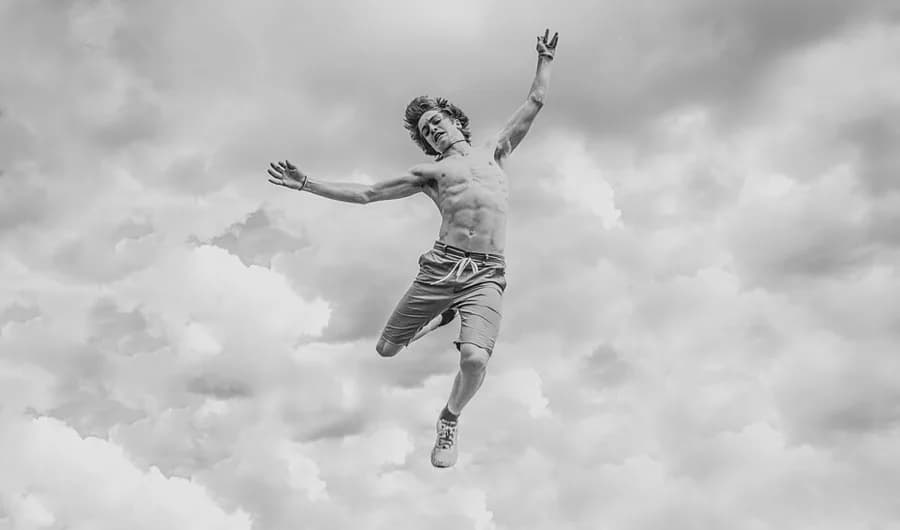
- Gliding motionless, arms open, as if carried: a grace received after the ordeal, the lightness of letting go.
- Flying by night above your sleeping city: the perspective finally taken on your own existence.
Frequently Asked Questions
Is flying in a dream always a good sign?
Why do I struggle so much to take off in my dreams?
What does flying over water mean?
Can dream flight trigger lucidity?
Questions and Answers
Is flying in a dream always a good sign?
Mostly yes: liberation, confidence, gained perspective. But a flight triggered by panic, to escape a danger, reverses the meaning: it is a flight away. Ask yourself what you were leaving behind the moment you took off.
Why can't I take off, or stay so low?
Heavy legs and hedge-hugging flights signal the inner brake: doubts, undigested obligations, loyalties that clip your wings. Find what in your day contradicts your lift-off — the answer is rarely in the dream, almost always in the diary.
What does flying over water mean?
Water and flight combine two registers: that of emotions and that of height. Flying over calm water speaks of quiet mastery — you feel without drowning — while skimming the waves marks a balance still fragile, asking for a few more metres.
Can you become lucid while flying?
It is one of the most reliable triggers: whoever notices they are flying almost always understands they are dreaming. To stabilise lucidity, fix a detail of the landscape, rub your hands or spin on yourself instead of rushing towards the ground.
What if take-off terrifies me in the dream?
Fear in flight speaks of responsibility: height exposes, freedom commits. It can signal an ambition growing faster than your sense of deserving it. Deliberately descending a notch in the next dream — or choosing where to land — often turns vertigo into confidence.